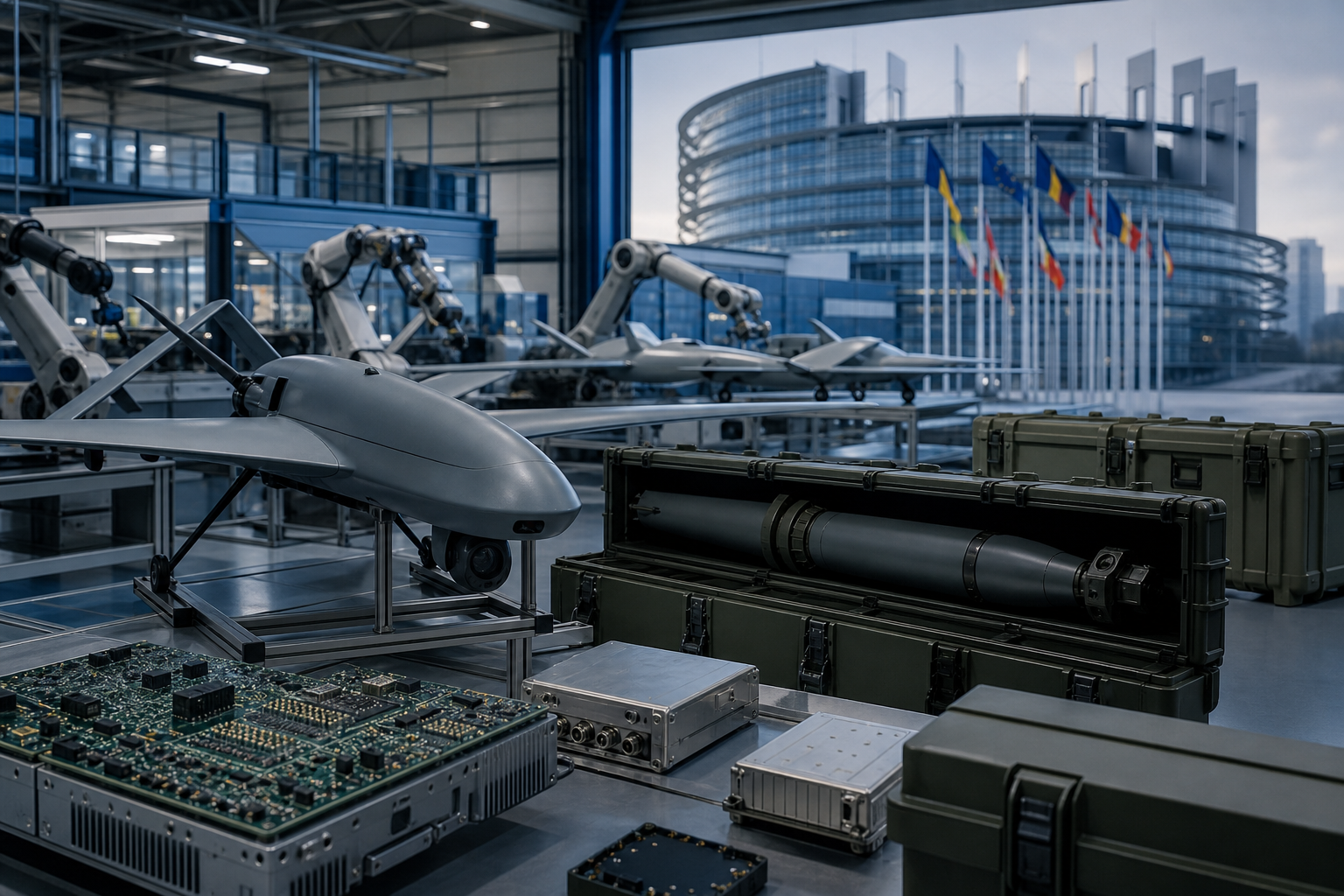
President Ursula von der Leyen said on 17 September that the European Union would disburse €3.3 billion to Ukraine on 18 September for missile and drone procurement. [1] The announcement is a material operational step within the EU’s Ukraine Support Loan, rather than a further political declaration of solidarity. But it should not be mistaken for an immediate addition of €3.3 billion worth of usable capability at the front. The policy test begins once financing reaches contracts, suppliers allocate production slots, and equipment is delivered, integrated and sustained.
The distinction is important. Ukraine’s requirements span systems with radically different production cycles: expendable drones can often be produced and adapted rapidly, while missiles—especially air-defence interceptors—depend on scarce components, established production lines, export permissions and demanding integration arrangements. The new transfer can therefore improve Ukraine’s ability to place orders and provide suppliers with firmer demand signals. It cannot, by itself, resolve the physical bottlenecks that determine when missiles or drones become available.
What changed
The €3.3 billion payment follows a sequence of EU decisions intended to make the Ukraine Support Loan a channel for defence-industrial support as well as macro-financial assistance. Regulation (EU) 2026/467 establishes a loan of up to €90 billion for 2026–27, including support for Ukraine’s defence industrial capacities. It specifies that defence-related disbursements are linked to contracts or agreements for relevant activities, expenditure and measures, rather than being unrestricted budget support. [3]
The Commission had previously reported a €3.9 billion payment on 30 June as the first instalment of a tranche of around €6 billion dedicated to drone procurement. [4] It also approved a further €6.1 billion on 11 September for air and missile defence, ammunition, drones and electronic warfare, stating that the decision enabled procurement of PAC-3 missiles for Patriot systems after agreement by member states. [5] The newly announced €3.3 billion payment should therefore be understood as part of a rolling procurement-and-disbursement architecture, not as a standalone package.
That architecture has two notable features. First, it is designed to support Ukrainian as well as European production. The Commission has framed the loan as a means to rebuild, modernise and integrate Ukraine’s defence technological and industrial base with the European base. [3] Second, it includes a constrained mechanism for procuring outside the preferred Ukrainian, EU and EEA-EFTA supplier space when urgent needs cannot be met in the necessary quantities or timeframe. The Commission describes this derogation as exceptional and strictly limited. [4]
Why the transfer matters—and what it cannot do
For Ukraine, finance at this scale can matter immediately in commercial terms. It can convert demand that might otherwise remain provisional into orders with deposits, contractual milestones and delivery schedules. That is particularly valuable for drone producers, whose production can be expanded through investment in components, testing, software, payloads and manufacturing capacity. It can also support a more regular order book for Ukrainian firms operating under wartime conditions.
For European policy, however, the more difficult question is whether the facility creates additional capacity or merely reallocates scarce output. If orders draw on already constrained missile and interceptor production without corresponding expansion, Ukraine may receive equipment sooner only at the cost of deferring replenishment for European armed forces or other customers. Such trade-offs need not invalidate the policy: they may be strategically justified. But they must be made explicit, managed jointly and accompanied by credible plans to increase output.
Missile procurement is the clearest stress case. The Commission’s September approval explicitly connected EU support to air and missile defence and to PAC-3 procurement. [5] These are not products for which money alone can quickly create supply. Their delivery depends on industrial capacity, technical specifications, contractual priority, national export decisions and the ability to keep launcher, radar, command-and-control and interceptor stocks coherent. A funding instrument that treats all defence products as financially interchangeable will obscure these differences.
Drones present a different, though not uncomplicated, opportunity. Their shorter development cycles and Ukraine’s accumulated operational experience make them suitable for rapid procurement and iterative improvement. Yet drones also rely on vulnerable supply chains: electronics, optics, motors, batteries, communications links and electronic-warfare resilience. The strategic value of financing is highest when it supports scalable production, diversified components and repairability—not simply the purchase of large numbers of platforms designed for a previous phase of the war.
A test of EU procurement design
The central policy issue is not whether Europe can mobilise a large headline amount. The EU has already established the legal authority to disburse loan assistance in instalments, and the regulation requires the Commission to act without undue delay after a positive assessment of a compliant request. [3] The harder issue is whether the system can consistently match procurement speed to Ukraine’s operational tempo while preserving financial control and European industrial objectives.
This requires three linked disciplines.
- Contract visibility: policymakers need a consolidated picture of which contracts are funded, their intended delivery windows, supplier location, and whether they add capacity or use pre-existing slots. Public disclosure will necessarily be limited by security concerns, but aggregate reporting can still permit meaningful oversight.
- Portfolio management: the EU should distinguish between rapid-turnover drone purchases, medium-term production expansion, and long-cycle missile and air-defence orders. Combining them in one financial headline risks masking the fact that they require different contracting methods and performance indicators.
- Replenishment planning: EU and national procurement authorities must identify when support for Ukraine competes with member-state stock rebuilding. Joint multi-year orders, advance purchasing of key components and agreements on capacity expansion are more likely to avoid a zero-sum allocation of limited output.
The derogation mechanism is also a practical indicator of industrial readiness. Where Ukraine cannot obtain a product in the required quantity or within the required time from Ukrainian, EU or EEA-EFTA suppliers, external procurement may be permitted under the loan’s conditions. [4] This can be operationally necessary, particularly for specialised interceptors. Yet frequent reliance on derogations would also signal a mismatch between Europe’s stated ambition for a more integrated defence-industrial base and its ability to supply high-demand capabilities at speed.
Strategic implications
The announced disbursement strengthens a model in which Ukrainian combat demand informs European industrial policy. This is strategically rational: Ukraine provides unusually direct evidence about the performance, attrition and adaptation needs of drones, counter-drone systems, electronic warfare and air defence. Financing that translates this experience into co-production and durable supplier relationships could improve both Ukraine’s immediate resilience and Europe’s future readiness.
There is, nevertheless, a risk in equating battlefield urgency with sound long-term procurement. Emergency demand can favour available equipment over interoperable equipment, and rapid orders can fragment standards if every purchase is treated as a separate exception. The EU should therefore use the loan not only to purchase systems but also to reinforce common requirements for data links, electronic-warfare resilience, maintenance, ammunition compatibility and secure supply chains. The objective should be faster delivery now without embedding avoidable fragmentation later.
The political claim will also need to be calibrated. The 17 September announcement is evidence of an intended disbursement, reported for 18 September; it is not yet evidence of contracts performed or deliveries completed. [1] Future Commission reporting should distinguish clearly between amounts approved, funds disbursed, contracts signed, production capacity financed, and equipment delivered. Those are separate stages, and collapsing them into a single number weakens accountability precisely where the policy’s credibility is most exposed.
What to watch
- Whether the Commission confirms the 18 September transfer and identifies the legal and programme channel through which it was made.
- Whether funded procurement is weighted toward Ukrainian production, EU suppliers, or exceptional third-country sourcing.
- Whether the money secures new production capacity and delivery slots rather than reallocating existing inventories.
- Whether missile and air-defence orders are accompanied by credible delivery schedules and member-state replenishment measures.
- Whether EU reporting separates financial execution from delivered operational capability.
The €3.3 billion disbursement is therefore best assessed as a test of conversion: from European financial mobilisation to contracted industrial output, and from contracted output to sustained Ukrainian capability. Success would demonstrate that the EU can finance fast replenishment without simply intensifying existing bottlenecks. Failure would not be defined by delay alone, since complex defence production takes time. It would be defined by an inability to show where the money is generating additional, deliverable capacity.